October 22, 2009

The 39 Clues: One False Note by Gordon Korman


The second in the 39 Clues series, I found One False Note even more intriguing than the first. The Cahill kids continue to trek across Europe, narrowly escaping their family members in pursuit of the clues (and fortune, fame, etc.). In an effort to not repeat myself in each of these 39 Clues posts, I'll cut right to the chase: my questions/comments.
1. The series seems committed to involving readers in the hunt for the clues. The front cover of each book comes with 6 game cards packed neatly inside, and if you visit the website you can use the codes on the cards to play along and earn clues. In each book I've noticed a deviation from the normal page numbering at some point, and for 20 or so pages the corners will be marked with a series of numbers/letters. Although I myself haven't been motivated enough to play along, I can only assume readers can find additional clues that way. I'm hoping when I start a book club with the first book, I'll have kids willing to do the legwork on this investigating for me.
2. I can distinctly remember the opening to every Baby-sitters Club book, where Ann M. Martin reiterated the situation of each character so you could follow along even if the first one you read was, say, BSC #74 (because, you know, those were complicated scenarios. Claudia had diabetes. You had to know that to understand the tension when someone brought ding-dongs to the meetings.) It annoyed me then. It annoys me now.
3. The kids are travelling around the world, and all the clues are rooted in history. A+ for accidental knowledge gained by readers in the areas of history/the arts/languages/etc.
4. The Cahills are averaging one clue found per book. I think I read that the series is only going to have 7 or 10 books - I know I'm not a math teacher, but... I'm curious to see how it plays out. I actually have a vague theory, but I won't ruin it for those of you who haven't read the books yet.
5. Why does the cat say "Mrrp?" Seriously. Why?
On my book log in my classroom (the one on giant chart paper so the kids can keep tabs on my reading), I rated #1 an 8 and #2 a 9. I'm definitely hooked enough to keep reading, and I'm confident my kids will really enjoy them as well.

October 17, 2009

Diary of a Wimpy Kid: Dog Days by Jeff Kinney


The fourth book is here, and 9- to 12- year olds across the country couldn't be happier. After advertising and organizing the pre-orders at school through our Scholastic Book Fair, I found myself at Target on the 12th and grabbed one off the shelf myself to read immediately. Yes, the next day I was ordering a delivery to be rushed to my school. Yes, two days later a box of 46 copies was to arrive at my door. But I could not resist getting in on the fun of the much anticipated release date.
As for the book itself? Still entertaining. This one details Greg's summer vacation of: trying to laze around the house, lamenting family bonding time, and the beginning of the end (at least it seems) of his friendship with Rowley. Oh, and trying to be macho in front of the cute girl at the pool, of course. After reading 4 DWK books, I'm still bothered that Greg is so oblivious to the things he does that are mean or obnoxious to others. I still look for that brief glimpse of "oh I shouldn't have done that" or "why don't I do something at least a little bit nice to make up for it," but I know that's not the reality of his character. In the meantime, I'm still loving how wildly entertaining they are to kids and could not be happier as a teacher that I have students who LOVE. TO. READ. Kinney's books.

October 10, 2009

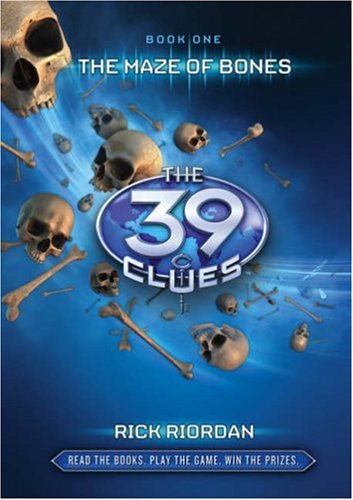
The 39 Clues: The Maze of Bones by Rick Riordan


The new series The 39 Clues stars brother and sister orphan duo Amy and Dan Cahill as they trek around the world, finding clues to solve an ancient family mystery. With an au pair to assist them, the kids travel from country to country in an attempt to find clues that will ultimately lead them to an unknown, yet infinitely powerful, prize. The Cahill kids aren't the only ones trying to solve the mystery, of course. Their extended family members have formed teams in search of clues as well, and despite family ties they seem to stop at nothing to get ahead in the chase.
The 39 Clues Book One: The Maze of Bones (guided reading level R) is written by Rick Riordan, but each book in the series is penned by a different author. With the clues connected to major historical figures, a young reader will get a nice history lesson along the way. Think: The Da Vinci Code for kids, only without the religious aspects.
I am hoping to use the series as a book club with some of my students a bit later in the year. Each book comes with a set of playing cards, and there's a website where readers can enter their card codes and play along with the mystery online.

September 27, 2009

Phyllis Reynolds Naylor!


I had the distinct pleasure of attending an author's dinner with Phyllis Reynolds Naylor at the fancy downtown restaurant Chef Geoff's last week (thanks to Scholastic for hosting the event!). As I told my students the next day, it was just like my own Dear Mr. Henshaw moment and I was pleased as punch to sit right next to Ms. Naylor during dinner. She was, of course, entirely sweet and adorable as she asked me about what my students are interested in reading these days (I gave a shout out to Jeff Kinney's DWK series, as I should have given the rate they fly off the shelves in my classroom) and shared stories of her writing life with us. Later in the evening she shared her remarks on her newest book, Faith, Hope, and Ivy June, after which Scholastic gave us each a copy of and she signed them all.
Favorite story of the night: Over dessert, Phyllis asked my table if we would like to hear the story of when she won the Newberry for Shiloh. After a resounding "YES!" she proceeded to explain that she was eating her cereal one morning while her husband was out for a jog when the Newberry committee called her. "You've won the Newberry!" they exclaimed. "But my book only got one star!" Phyllis exclaimed back. After assuring her that they all loved her work, the committee shooed her off the phone so she could answer the forthcoming phone call from The Today Show. After hanging up with the committe, Phyllis admitted that she wasn't sure whether it had all really happened or not. She figured she would just stand and stare at the phone - and if it rang, and if the voice on the other end was from The Today Show, she would know it was true. Sure enough, the phone rang and within minutes she was recieving instructions to pack her bags and get to New York by that evening so she could be on national tv the next morning. After explaining what a shock it was to be expected to be in New York that very same night, Phyllis then said, "My husband says that when he got home from his jog, I was standing on the front porch and I said, 'Rex - I have 24 hours to lose 30 pounds!'"
Many thanks to Phyllis Reynolds Naylor for such a wonderful evening.

September 13, 2009

Ivy and Bean Take Care of the Babysitter


I love Ivy and Bean books (guided reading level M-N) because they're finally something different than Junie B. Jones - and they're good for a similar low-level reader. The plot formula seems to be the same in each book: Bean gets into a lot of things she shouldn't; somewhere along the way she drags Ivy into the mix; in the end she makes her big sister mad and then maybe will get in a bit of trouble with her mother.
I used to worry about books with characters that set less than stellar examples of behavior for kids (okay, so I still worry about it sometimes) - but what I once read was that it's good for kids to read books where the characters are kids doing bad things, because then the readers get to live out the trouble-making vicariously and not actually do the bad things themselves. So here's crossing my fingers that none of my students start climbing into locked crawl spaces or ruining their neighbors' yards with massive amounts of mud anytime soon...

August 29, 2009

Heartbeat by Sharon Creech

I'm not sure why I never took much notice of Heartbeat when it was in my library last year - maybe because most of my students had overlooked it; or because I hadn't read Love That Dog or Walk Two Moons; or because even though I noticed the cover, I wasn't immediately drawn into the book by the yellow apple. A rushed grab-anything-off-the-shelf-you-haven't-read-yet on the last day of summer school, however, led me to finally read Heartbeat on the flight to my vacation. And how glad I am that I did! The story of a young girl who loves to run, her friend Max who shares a love of the sport, and her small family - pregnant mom, dad, and elderly grandpa - is sweetly simple yet intellectually interesting at the same time. I loved the narrator's strong voice and sense of self as she attempts to make sense of those around her. I will definitely book talk it this fall - since it's written in poetry it may be a hard sell for some kids at first - but ultimately would be a pretty simple read for many junior high students (guided reading level W: great for 6th/7th; a good push for 5th).

August 16, 2009

Diary of a Wimpy Kid: The Last Straw by Jeff Kinney


The third book in the Wimpy Kid series, I found this to be the funniest one yet. My students had started reading it before me because I couldn't hold them off once the new copies arrived at school - even for the few hours it would have taken me to read it! After hearing so many of my kids laugh out loud during our SILENT reading zone time (it was painful, but I managed to tolerate it without getting mad at anyone enjoying a book :) ), I was hardly surprised when I, too, actually laughed out loud while reading a few parts. The conflict in The Last Straw is between Greg and his father, with the usual other characters playing their usual roles. Highly enjoyable, and still seems a great fix for reluctant readers in older grades.

State of the Blog

I recently attended a seminar on reader's workshop where the presenter, Frank Serafini (love him!), said something that stuck with me. I am paraphrasing here, but it was along the lines of if we are to be teachers of literacy in today's age, we ourselves must be literate in ALL the ways our students are/will be literate. That is, we need to not only read literature - for ourselves, for our students - but we need to read websites and blogs and tweets and all the rest. And furthermore, we should be posting on websites and blogging on blogs and tweeting on twitter! This forced me to remember that once upon a time I had, in fact, started a blog that I promptly dropped when life got busy...
So here it is! All out of order, posts moved from the old blogger site to this one, reformatted and thrown into disarray without any bells and whistles. My thoughts on children's books, as I read them.

No Talking & The Landry News by Andrew Clements


No Talking:
I really enjoyed this new Clements book. As is typical of his stories, it matches kid vs. school-adult in a large battle of wills. This time, the main character begins a contest at his school to see if all the 5th graders can stop talking for two days. Each chapter follows a different character’s involvement, from the students (it’s a boy-girl contest) to the teachers to the principal. It doesn’t exactly leave the reader with many enduring thoughts, but is enjoyable while reading. I think most kids would at least consider what daily life would be like if they completely stopped talking - and a few intrigued readers would probably attempt to do so (although maybe only for a few minutes, at best)!

The Landry News:
Again, a really typical Clements book - quick & enjoyable! I think my only complaint is that the main conflict isn’t a very believable one - it was a bit hard to see more than just one side of the story. But, I liked the main characters (a girl who writes her own newspapers and the burned-out teacher who finally begins teaching again to help her) and the plot moved along quickly. The best part, I thought, was that the formatting of the chapters, pictures, font, etc. is newspaper-like. Clements also works in some decent insight about kids of recent divorce, so perhaps a particularly good recommendation for a student who has divorced parents.

Clockwork by Philip Pullman


This turned out to be a creepy little fantasy-fiction story about an apprentice clock-maker, a disturbing doctor, and sickly prince in a small German town. The story is well-crafted, with several storylines coming together like the gears of a clock. It is written on a pretty advanced reading level (guided reading level Z) and might be hard for some students to follow if they’re not prepared for reality and fantasy to entertwine so closely. There’s plenty of evil and fantasy (and even a few untimely deaths) to keep the Steven-King bound reader engaged.